JEE Preparation Tracker
Calculate Your Daily Study Hours
Daily Study Breakdown
Current: hours/day
Required: hours/day
Progress Through Phases
Phase 1: Foundation (Days 1-30)
Phase 2: Drills (Days 31-120)
Phase 3: Precision (Days 121-180)
Recommended Actions
Can you really crack IIT JEE in just six months? The short answer: yes-but only if you’re willing to treat every hour like it’s your last chance. Thousands of students have done it. Not because they were geniuses, but because they stopped hoping and started doing. If you’re reading this in December 2025, maybe you just realized your board exams are over, or your coaching didn’t click, or you lost months to burnout. It’s not too late. But it’s not easy either.
What You’re Really Up Against
IIT JEE isn’t a test of memory. It’s a test of speed, accuracy, and problem-solving under pressure. In 2025, over 1.5 million students appeared for JEE Main, and only about 25,000 made it into any IIT. That’s less than 2%. But here’s the thing: you don’t need to be in the top 1%. You just need to be in the top 10% of the serious ones.
The syllabus? Massive. Physics, Chemistry, and Math together cover 200+ topics from Class 11 and 12. But here’s the good news: 70% of the questions come from just 30% of the topics. Focus on those. Don’t try to learn everything. Learn what matters.
Phase 1: The First 30 Days - Build Your Foundation Fast
Forget full-length books. You don’t have time. Start with NCERT. Yes, NCERT. It’s the base for 60% of JEE Main questions. Read it like a detective. Highlight formulas. Write down common traps. For example, in Chemistry, organic reactions like nucleophilic substitution and elimination are repeated every year. Memorize the patterns, not just the reactions.
For Physics, focus on these high-yield topics:
- Newton’s Laws and Friction
- Work, Energy, Power
- Rotational Motion
- Electrostatics and Current Electricity
- Optics and Modern Physics
For Math, nail these:
- Quadratic Equations and Inequalities
- Sequences and Series
- Coordinate Geometry (Straight Lines, Circles, Parabolas)
- Calculus (Limits, Derivatives, Integrals)
- Probability and Permutations
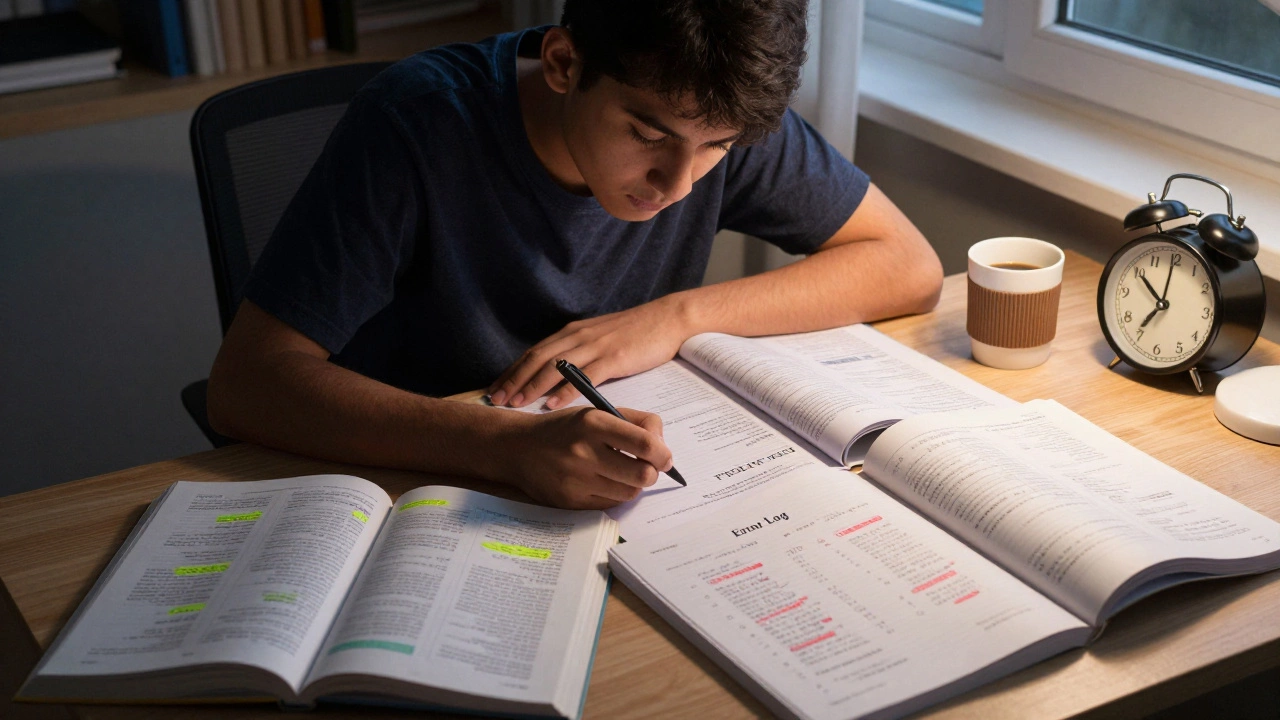
Do 2 hours of theory per day. Then switch to solving 15-20 problems. No more, no less. Quality over quantity. If you get a question wrong, write down why. Not just the solution-why you got it wrong. Was it a formula mix-up? A calculation error? A conceptual gap? Track it in a notebook. This becomes your personal enemy list.
Phase 2: Days 31-120 - Drill, Simulate, Repeat
This is where most people fail. They keep studying but never test themselves like the real exam. You need to train your brain to perform under time pressure.
Start taking timed mock tests every other day. Use previous years’ papers from 2020-2025. Don’t wait until you feel ready. You won’t feel ready. You’ll feel overwhelmed. That’s normal.
Here’s the drill:
- Set a timer for 3 hours (real exam time).
- Use only a pen and paper. No calculator. No phone.
- After the test, spend 2 hours analyzing every mistake.
- Group your errors: Conceptual? Calculation? Speed? Guessing?
- Fix the top 3 error types before your next test.
By day 90, you should be scoring at least 150+ in JEE Main mocks. That’s not amazing-but it’s enough to qualify. If you’re scoring below 100, you’re still studying, not preparing. Change your method.
Chemistry is your secret weapon. Inorganic Chemistry is pure memorization. Make flashcards. Stick them on your wall. Review them every morning and night. Organic mechanisms? Learn the logic: electron flow, stability, steric hindrance. Don’t memorize 50 reactions. Learn 5 patterns and apply them.

Phase 3: Final 30 Days - Precision Over Effort
Now you’re not learning. You’re fine-tuning.
Stop new topics. Stop reading new books. Focus only on your error log. Re-solve every question you got wrong in the past 90 days. If you still get it wrong, mark it as ‘critical’. Ask someone-teacher, friend, YouTube tutor-to explain it to you in a different way.
For Physics, memorize the 10 most common numerical types:
- Projectile motion range and height
- RC circuit time constant
- Spring-block oscillation frequency
- Thermal expansion of rods
- Photoelectric effect stopping potential
- Capacitor combinations in series/parallel
- Doppler effect in sound and light
- Refraction through prisms
- Lenz’s Law direction
- Half-life and decay constant
For Math, memorize these shortcuts:
- Sum of first n natural numbers: n(n+1)/2
- Area under parabola y²=4ax: (8/3) a²
- Binomial coefficient trick: C(n,r) = C(n,n-r)
- Integration of e^x(f(x)+f’(x)) = e^x f(x)
For Chemistry, know the exceptions:
- Be and Mg don’t form peroxides
- LiF is insoluble, but others are soluble
- BF₃ is Lewis acid, not Lewis base
- NO₂ is paramagnetic, N₂O₄ is diamagnetic
Practice one full mock every 3 days. Time yourself strictly. If you finish early, go back and check only the questions you were unsure about. Don’t redo everything. That’s wasted energy.
What to Avoid at All Costs
Don’t do this:
- Watching 2-hour YouTube lectures on topics you’ve already covered
- Buying 10 new books because someone said they’re ‘best’
- Comparing your progress with someone else’s
- Sleeping less than 6 hours for more than 3 days in a row
- Thinking ‘I’ll start tomorrow’
One student I know cracked IIT Bombay in 5 months. He slept 7 hours, ate well, and took one 30-minute walk every day. He didn’t study more than 8 hours. But he studied with full focus. He knew his weak spots. He didn’t waste time on what he already knew.
Realistic Expectations
Can you get into IIT Bombay or IIT Delhi in 6 months? Maybe. But it’s rare. Can you get into IIT Guwahati, IIT Roorkee, or IIT BHU? Absolutely. Many students do. The top IITs are competitive. But there are 23 IITs. And most of them have seats left for students who score between 180-220 in JEE Advanced.
If you’re aiming for NITs or IIITs, you don’t even need JEE Advanced. JEE Main rank 10,000-30,000 gets you into top NITs. That’s achievable in 6 months with discipline.

Final Tip: The 80/20 Rule
You don’t need to master everything. You need to master what gets you marks. In JEE Main, 40% of the paper is easy. 40% is medium. 20% is hard. Your job? Get all the easy and medium ones right. That’s 80% of the paper. You don’t need to solve the hardest problems. You just need to avoid losing points on the easy ones.
That’s the difference between failing and qualifying.
What Success Looks Like
By day 180, you should be able to:
- Solve a JEE Main paper in 2 hours 45 minutes with 90% accuracy
- Identify the topic of a question within 10 seconds
- Know which questions to skip and come back to
- Stay calm even if the paper feels tough
- Walk into the exam hall knowing you’ve done everything you could
That’s not luck. That’s preparation.
Is it possible to crack IIT JEE in 6 months without coaching?
Yes, but you need structure. Coaching gives you a schedule, tests, and feedback. Without it, you have to build all three yourself. Use free resources like NPTEL, Khan Academy, and YouTube channels like Unacademy JEE or Physics Wallah. Take mock tests from official NTA websites. Keep a daily study log. Track your progress. If you’re consistent, coaching is just a support system-not a requirement.
How many hours should I study daily to crack IIT JEE in 6 months?
Focus on quality, not quantity. 6-8 focused hours a day is enough if you’re not distracted. That includes 2 hours of theory, 4 hours of problem-solving, and 1 hour of revision and error analysis. Studying 12 hours while half-asleep or scrolling through Instagram won’t help. Your brain needs rest to consolidate learning. Sleep is part of your study plan.
Which subjects should I prioritize in the last 3 months?
Prioritize based on your strength and scoring potential. For most students, Chemistry gives the fastest returns because it’s memory-based. Physics is high-weightage but tricky. Math is scoring if you practice patterns. So if you’re weak in Chemistry, spend 40% of your time there. If you’re strong in Math, keep practicing speed. Don’t waste time on your strongest subject unless you’re aiming for top 100 ranks.
Can I crack JEE Advanced in 6 months if I only prepared for JEE Main?
JEE Advanced is harder, but not completely different. If you’ve prepared well for JEE Main, you already know 70% of what’s needed. The difference? JEE Advanced tests deeper understanding and multi-concept problems. Start solving past JEE Advanced papers from 2020-2025 after you’re scoring above 180 in JEE Main mocks. Focus on reasoning, not just calculation. Don’t skip the 3-5 toughest questions-they’re worth more marks than you think.
What if I fail after 6 months of hard work?
You won’t fail-you’ll learn. Even if you don’t get into an IIT, you’ll have built skills that no exam can take away: discipline, time management, problem-solving under pressure. You’ll be better than 90% of students who gave up early. Many students who didn’t crack IIT JEE in one attempt went on to top engineering colleges abroad or became successful engineers. One year is not a lifetime. This is just one step.
Next Steps
If you’re reading this now, take 10 minutes right now. Open a notebook. Write down:
- What your weakest subject is
- What your strongest subject is
- Which 3 topics you’re most afraid of
- What time you’ll start studying tomorrow
Then set an alarm for 6 AM. The clock is ticking. Not because you’re behind. But because you’re ready.