
Can you really learn coding in three months? The answer isn’t a simple yes or no. It depends on what you mean by "learn." If you want to build a working website, automate a boring task, or land an entry-level job, then yes - it’s possible. But if you think you’ll become a senior developer or master complex algorithms in that time, you’re setting yourself up for frustration.
What Does "Learning Coding" Actually Mean?
Most people who ask this question aren’t trying to write the next operating system. They want to build something real - a personal portfolio, a small app, or maybe switch careers. That’s doable. But you need to be specific. Coding isn’t one thing. It’s dozens of tools, languages, and workflows bundled together.
For example, learning HTML and CSS so you can make a simple landing page takes about two weeks with consistent practice. Adding JavaScript to make buttons work and forms submit? That’s another four weeks. If you throw in a framework like React, you’re already past the three-month mark - unless you’re laser-focused on one path.
Most beginners get stuck because they jump between Python, JavaScript, Java, and Ruby without mastering any. Pick one language and stick with it for the first 90 days. JavaScript is the safest bet if you want to build things you can show off quickly. Python works well if you’re interested in data or automation.
A Realistic 3-Month Coding Plan
Here’s what a focused, daily schedule looks like for someone with no prior experience:
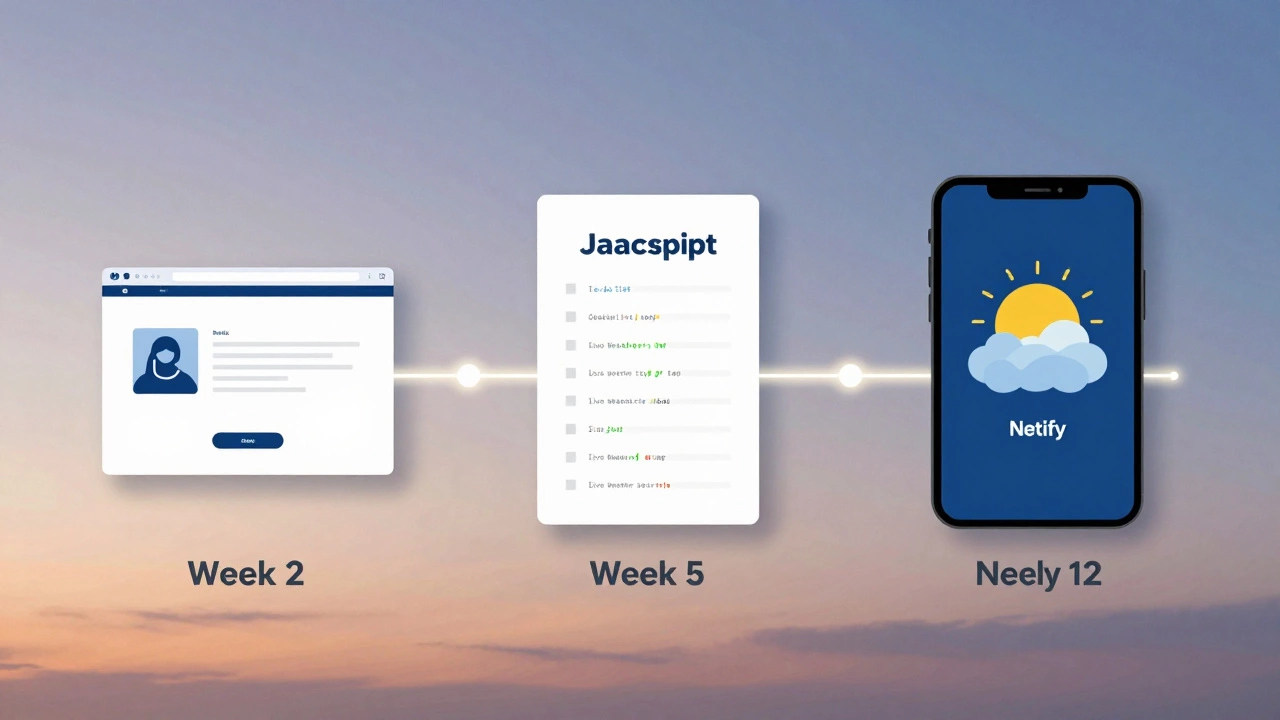
- Weeks 1-2: Basics of HTML and CSS - Learn how to structure a webpage and style it. Build a simple personal bio page. No frameworks. Just raw code.
- Weeks 3-6: JavaScript Fundamentals - Variables, functions, loops, conditionals. Make a to-do list that saves items to the browser. Learn how to connect buttons to actions.
- Weeks 7-8: Build a Mini Project - Create a weather app that pulls data from a free API. This teaches you how to fetch and display real data - a huge leap from static pages.
- Weeks 9-10: Version Control with Git - Learn how to save your work using GitHub. This isn’t optional anymore. Employers expect it.
- Weeks 11-12: Deploy Your Project - Use Netlify or Vercel to make your weather app live on the internet. This is the moment it stops being a homework assignment and becomes a real portfolio piece.
That’s it. No theory overload. No memorizing syntax. Just building. By the end, you’ll have a working website, a GitHub profile, and the confidence to say, "I built this."
What You Won’t Learn in 3 Months
Don’t expect to understand databases like PostgreSQL or write backend code with Node.js and Express unless you’re spending 40+ hours a week. You won’t master algorithms or data structures in depth. You won’t know how to debug complex system errors or optimize performance at scale.
That’s okay. Those skills take years. What you can build in 90 days is enough to get hired as a junior front-end developer, freelance on Upwork, or land an internship. Companies aren’t looking for experts. They’re looking for people who can ship code, learn fast, and solve small problems.
In Cape Town, tech startups and digital agencies often hire junior developers who can handle basic websites and fixes. You don’t need a degree. You need a portfolio. Three months is enough time to build three solid projects if you’re consistent.
How Much Time Do You Really Need?
People say, "I don’t have time." But time isn’t the problem - consistency is. If you can put in 15 hours a week (about 2 hours a day, five days a week), you’ll make progress. If you only do 5 hours, you’ll stall. If you do 25 hours, you’ll move fast.
Here’s a real example: A student in Johannesburg started coding on a free laptop, using only YouTube and freeCodeCamp. She spent 18 hours a week for 12 weeks. By the end, she had built a restaurant booking site, a budget tracker, and a quiz app. She applied to three local startups and got two interviews. She landed a remote internship paying R8,000 a month.
You don’t need a fancy computer. You don’t need to pay for courses. You just need to show up every day and build something, even if it’s small.
Common Mistakes That Stop People
Most people quit before they hit month two. Why? Here are the top three reasons:
- Switching languages too often - Trying Python one week, then JavaScript the next. You’ll never get deep enough to build anything real.
- Watching tutorials without coding - Watching someone else code feels productive. But your brain doesn’t learn unless you’re typing it yourself.
- Waiting for perfection - Your first website will look ugly. Your code will be messy. That’s normal. Ship it anyway.
There’s a difference between learning and practicing. Watching a video is learning. Typing the code yourself, breaking it, fixing it, and making it work - that’s practicing. You need way more of the second.

Free Tools to Get Started (No Paywalls)
You don’t need to spend money. Here’s what actually works:
- freeCodeCamp - Complete the Responsive Web Design and JavaScript Algorithms certifications. They’re free and hands-on.
- MDN Web Docs - The official guide for HTML, CSS, and JavaScript. Better than any course.
- GitHub - Create an account and push your code there every week. It’s your resume.
- Netlify - Deploy your projects for free. No credit card needed.
- Replit - Write and run code in your browser. Great if your computer is slow.
These tools are used by real developers. They’re not flashy. But they work.
What Comes After 3 Months?
Three months is the starting line, not the finish. After that, you’ll need to pick a direction:
- Front-end - Learn React, CSS frameworks like Tailwind, and accessibility.
- Back-end - Try Node.js, Express, and a database like MongoDB.
- Data - Learn Python, Pandas, and how to clean and visualize data.
Don’t try to do all of them. Pick one and go deeper. The goal isn’t to know everything. It’s to know enough to get your first job or project.
Many people who start coding in three months end up working remotely for companies in Europe or the US. Remote jobs are growing fast in South Africa. You don’t need to move. You just need to build something people can see and use.
Final Thought: It’s Not About Talent
People think coders are geniuses. They’re not. They’re just stubborn. They kept going when it got hard. They made mistakes and fixed them. They didn’t wait for the perfect moment.
You don’t need to be smart. You need to be consistent. Build one thing this week. Build another next week. Keep going. In three months, you won’t believe how far you’ve come.