2-Year JEE Preparation Timeline Calculator
Find out if you have a realistic chance to crack IIT JEE in 2 years. This tool helps you calculate your daily study hours needed based on your starting point, target rank, and available time. It also shows you the phase-by-phase timeline you'll need to follow.
Your Preparation Timeline Calculator
Every year, thousands of students ask the same question: Is it possible to crack IIT in 2 years? The answer isn’t yes or no-it’s how. Two years is enough time to build a solid foundation, master advanced concepts, and train for the pressure of IIT JEE-if you treat it like a full-time job, not a side hustle. But it’s not for everyone. It demands discipline, strategy, and mental toughness. Let’s break down what it actually takes.
What Does ‘Crack IIT’ Really Mean?
Cracking IIT doesn’t just mean clearing JEE Main. It means landing a rank high enough to get into one of the top 7 IITs-like Bombay, Delhi, Madras, or Kanpur-for a core branch like Computer Science, Mechanical, or Electrical Engineering. In 2025, over 1.5 million students appeared for JEE Main. Only about 25,000 cleared JEE Advanced. Of those, roughly 12,000 got into the top IITs. That’s less than 1% of the total applicants. So you’re not just competing against your classmates-you’re competing against the top 2% of India’s brightest students.
Two years gives you 24 months. That’s 730 days. If you study 8 hours a day, that’s nearly 6,000 hours of focused prep. Compare that to students who start in class 11 and burn out by class 12-they often end up with half that time because of distractions, coaching overload, or burnout. Two years can be an advantage if you start smart.
Phase 1: Build the Foundation (Months 1-8)
The biggest mistake students make is jumping straight into advanced problems. You can’t solve a JEE Advanced-level physics question if you don’t understand Newton’s laws. Or if you can’t balance a chemical equation. Or if you don’t know how to integrate basic functions.
Months 1 to 8 are for mastering Class 11 and 12 NCERTs-front to back. Not just reading them. Solving every single example. Doing every exercise. Even the ones teachers skip. Physics needs clear conceptual clarity: kinematics, laws of motion, work-energy, rotational motion, thermodynamics. Chemistry? Organic reaction mechanisms, periodic trends, chemical bonding. Math? Algebra, trigonometry, coordinate geometry, calculus basics.
Here’s what works: one chapter per week. Two days to learn, two days to solve problems, one day to review mistakes. Use only one reliable book per subject-like HC Verma for physics, OP Tandon for chemistry, and RD Sharma for math. Don’t collect 10 books. Master one. Most toppers did exactly that.
Phase 2: Intensify and Practice (Months 9-16)
Now you switch from learning to applying. This is where most students fall behind. They think solving 50 problems a day is enough. It’s not. You need targeted practice.
Start solving previous years’ JEE Main papers-2019 to 2025. Do them under timed conditions: 3 hours for 90 questions. No phone. No breaks. Just you and the paper. After each test, analyze your performance. Not just your score. Your pattern. Did you keep missing electrostatics questions? Did you run out of time on calculus? Did you guess too many chemistry MCQs?
Track your weak areas in a simple notebook. Write down: Topic, Mistake Type, Why It Happened, How to Fix. Example: “Mistake: Forgot sign in integration. Why: Didn’t check limits. Fix: Always write limits above/below integral during practice.” This is how top rankers improve.
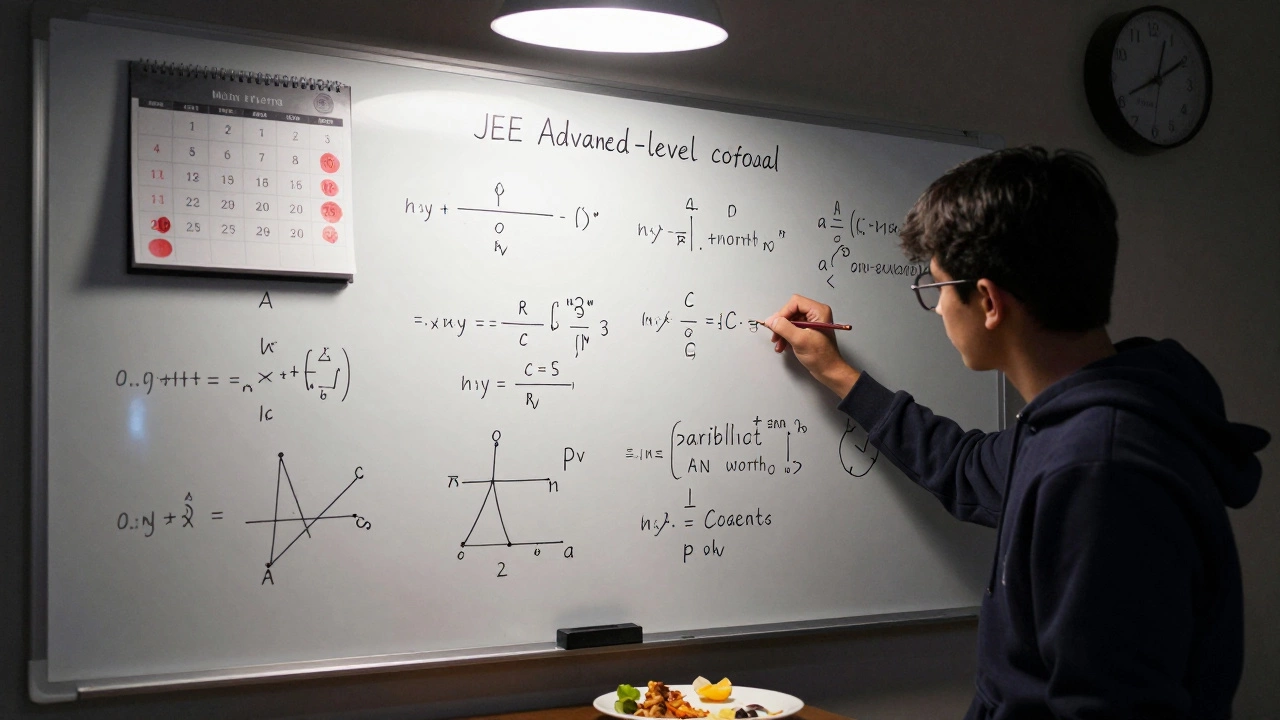
Start giving JEE Advanced level papers once every two weeks. Don’t aim for high scores yet. Aim for understanding. A 40% score on a JEE Advanced paper at this stage is normal. What matters is whether you can solve 70% of the questions after reviewing them. If yes, you’re on track.
Phase 3: Simulate and Refine (Months 17-24)
The final six months are about conditioning. You’re not studying anymore-you’re competing.
Take full mock tests every weekend. Use test series from reliable sources like Allen, Resonance, or FIITJEE. Don’t skip the analysis. Spend more time reviewing your test than taking it. If you got a question wrong because you misread the question, that’s a habit. Fix it. If you panicked during the physics section, practice breathing techniques. If you ran out of time, work on speed drills-solve 10 MCQs in 8 minutes, no calculator.
By month 20, you should be consistently scoring above 80% in JEE Main mocks. By month 22, you should be solving 70% of JEE Advanced papers correctly without help. That’s the threshold. If you’re not there, you need to adjust. Maybe drop one subject to focus on your top two. Maybe cut down on YouTube. Maybe stop comparing yourself to others.
Sleep matters. Eat well. Walk for 20 minutes daily. Your brain needs recovery. Top performers don’t study 14 hours a day. They study 8 hours with 100% focus. The rest is recovery.
What Doesn’t Work
Here’s what kills two-year plans:
- Switching books every month
- Watching 10-hour YouTube lectures without solving anything
- Doing 100 problems but never reviewing mistakes
- Waiting for ‘perfect timing’ to start
- Believing coaching alone will save you
Coaching helps-but only if you’re already doing the work. If you show up to class and zone out, it’s a waste. If you rely on coaching notes without solving problems yourself, you’ll fail. IIT JEE tests your ability to think, not your memory.
Who Has a Real Chance?
You have a real shot if:
- You’re willing to work 6-8 hours a day, 6 days a week
- You can stay consistent for 24 months without burning out
- You’re honest about your weaknesses and fix them fast
- You don’t need constant motivation-you have discipline
You probably won’t make it if:
- You think you can ‘cram’ in the last 6 months
- You’re studying because your parents want you to
- You’re distracted by social media or part-time jobs
- You compare your progress to someone who started in class 9
There’s no magic formula. But there is a proven path: learn → practice → analyze → repeat.
Real Stories, Not Myths
In 2024, a student from a small town in Bihar started JEE prep after class 10. He had no coaching. Just a smartphone, free YouTube channels, and a library. He studied 7 hours a day. He cleared JEE Advanced in 2025 with an All India Rank of 1,843. Got into IIT Kanpur for Mechanical Engineering.
Another student from Delhi started in class 11, but was distracted by exams, hobbies, and pressure. He switched to a two-year plan after failing in class 12. He restructured his schedule, dropped unnecessary subjects, focused on physics and math. He cleared JEE Main with a 98.7 percentile and got into NIT Trichy. He didn’t get an IIT-but he got a great engineering degree.
Cracking IIT isn’t about being the smartest. It’s about being the most consistent.
Final Checklist: Are You Ready?
Before you commit, ask yourself:
- Can I wake up at 6 AM and study without being reminded?
- Do I know my weak topics right now? Can I name them?
- Am I willing to give up social events, TV, and games for 2 years?
- Do I have a quiet place to study without distractions?
- Can I handle failing a mock test and still show up the next day?
If you answered yes to at least 4 of these, you’re ready. The rest is just execution.
What If You Don’t Crack It?
Let’s be real. Not everyone gets into IIT. But that doesn’t mean you failed. The skills you build in two years of JEE prep-problem-solving, time management, resilience-are worth more than a rank. You’ll be better than 90% of college students when you enter university.
If you don’t get into IIT, you still have options: NITs, IIITs, state engineering colleges, or even studying abroad. Many top engineers didn’t go to IIT. They went somewhere else-and worked harder.
Cracking IIT is a goal. But your worth isn’t tied to a rank. Your discipline is your real achievement.
Is 2 years enough to prepare for IIT JEE?
Yes, 2 years is enough if you start from scratch and study consistently. Most successful students who cracked IIT in 2 years began after class 10 and followed a strict daily schedule-6 to 8 hours of focused study, weekly mock tests, and detailed error analysis. It’s not about how long you study, but how well you use your time.
Can I crack IIT JEE without coaching?
Absolutely. Many toppers in recent years had no coaching. They used free YouTube channels (like Khan Academy, Unacademy Free), NCERT books, and previous year papers. Coaching helps with structure and tests, but not with understanding. Your ability to solve problems independently matters more than attending lectures.
Which subjects should I focus on first?
Start with Physics and Math. They form the backbone of JEE Advanced. Physics teaches you how to think logically, and Math is the language of problem-solving. Once you’re strong in these, Chemistry becomes easier because it’s more memory-based. Don’t ignore Chemistry, but prioritize depth in Physics and Math early on.
How many hours should I study daily?
Aim for 6 to 8 hours of focused study daily. That’s enough if you’re fully engaged. Studying 12 hours with distractions is less effective than 6 hours with full attention. Break your day into 90-minute blocks with 15-minute breaks. Use a timer. Track your productivity, not just hours.
Is it too late to start if I’m in class 11?
Not at all. Many students start in class 11 and still crack IIT. The key is to complete Class 11 syllabus in the first 6 months, then move to Class 12 while revising Class 11. Use your school time wisely. Don’t wait for coaching to teach you-learn ahead on your own. Starting in class 11 gives you a full 24-month window, which is ideal.
What if I fail JEE Advanced after 2 years?
Failing JEE Advanced doesn’t mean failure. You’ll still have a strong foundation in science and math, which opens doors to NITs, IIITs, state colleges, or even foreign universities. Many engineers who didn’t get into IIT went on to work at top tech companies, start successful startups, or pursue research. Your rank doesn’t define your future-your persistence does.